airflow-schedule-heatmap
Visualize how your Airflow DAG schedules are distributed across the day with an interactive heatmap
0.0
0 reviews•
Apache Airflow·
Python
Visualizing DAG Scheduling Patterns in Apache AirflowIn many Airflow environments, DAG schedules gradually end up clustered around a few common times — midnight, early morning, or the top of the hour....
About this project
Visualizing DAG Scheduling Patterns in Apache Airflow
In many Airflow environments, DAG schedules gradually end up clustered around a few common times — midnight, early morning, or the top of the hour.
Over time this can create unintentional scheduler spikes, where many workflows start simultaneously and compete for resources.
While Airflow provides great visibility into task execution, it’s harder to understand how schedules themselves are distributed.
So I built a small Airflow 3.x plugin to make scheduling patterns easier to see.
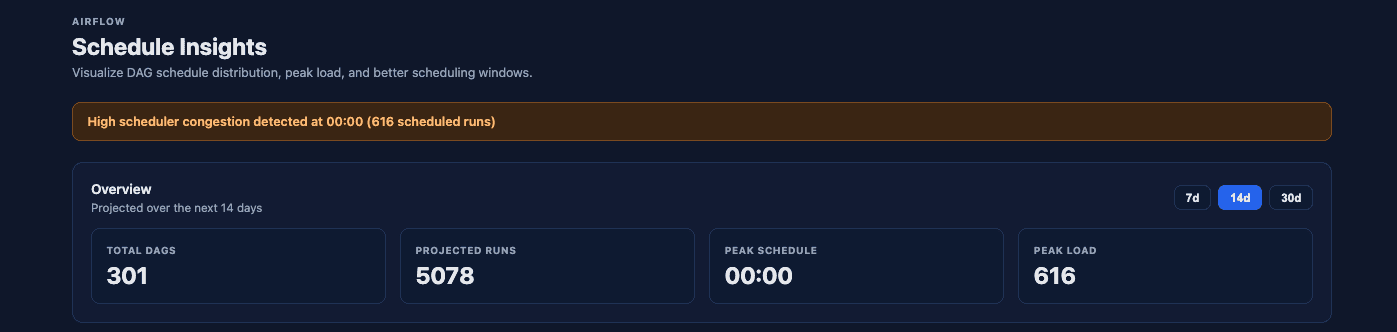
📊 Airflow Schedule Insights
The plugin analyzes DAG schedules and projects future runs to show how workflows are distributed across the day.
The dashboard includes:
🔹 Schedule Heatmap
Visualize DAG starts by weekday × hour
🔹 Scheduler Load Curve
See projected scheduler pressure across the day
🔹 Hourly Distribution
Understand how DAG runs are spread across 24 hours
🔹 Daily Scheduler Load
Identify free or low-load windows where new pipelines can be scheduled
This helps answer practical questions like:
• Why do so many DAGs start at midnight?
• When is the scheduler busiest?
• Where can a new pipeline be scheduled safely?
⚙️ How it works
The plugin:
1️⃣ Loads DAG definitions using DagBag
2️⃣ Uses Airflow Timetable APIs to project upcoming runs
3️⃣ Aggregates schedule activity over a configurable window (7 / 14 / 30 days)
4️⃣ Visualizes scheduler load through an interactive dashboard
🛠 Tech stack
• Apache Airflow 3.x
• FastAPI (plugin backend)
• React + ECharts (dashboard)
• Docker-based local Airflow setup
💡 Why I built this
As Airflow deployments grow, schedule design becomes just as important as DAG logic.
Understanding when workflows run can help teams:
• avoid schedule collisions
• distribute workloads more evenly
• plan new pipelines more effectively